Data-reading module diag_rb in the post-processing program diag 
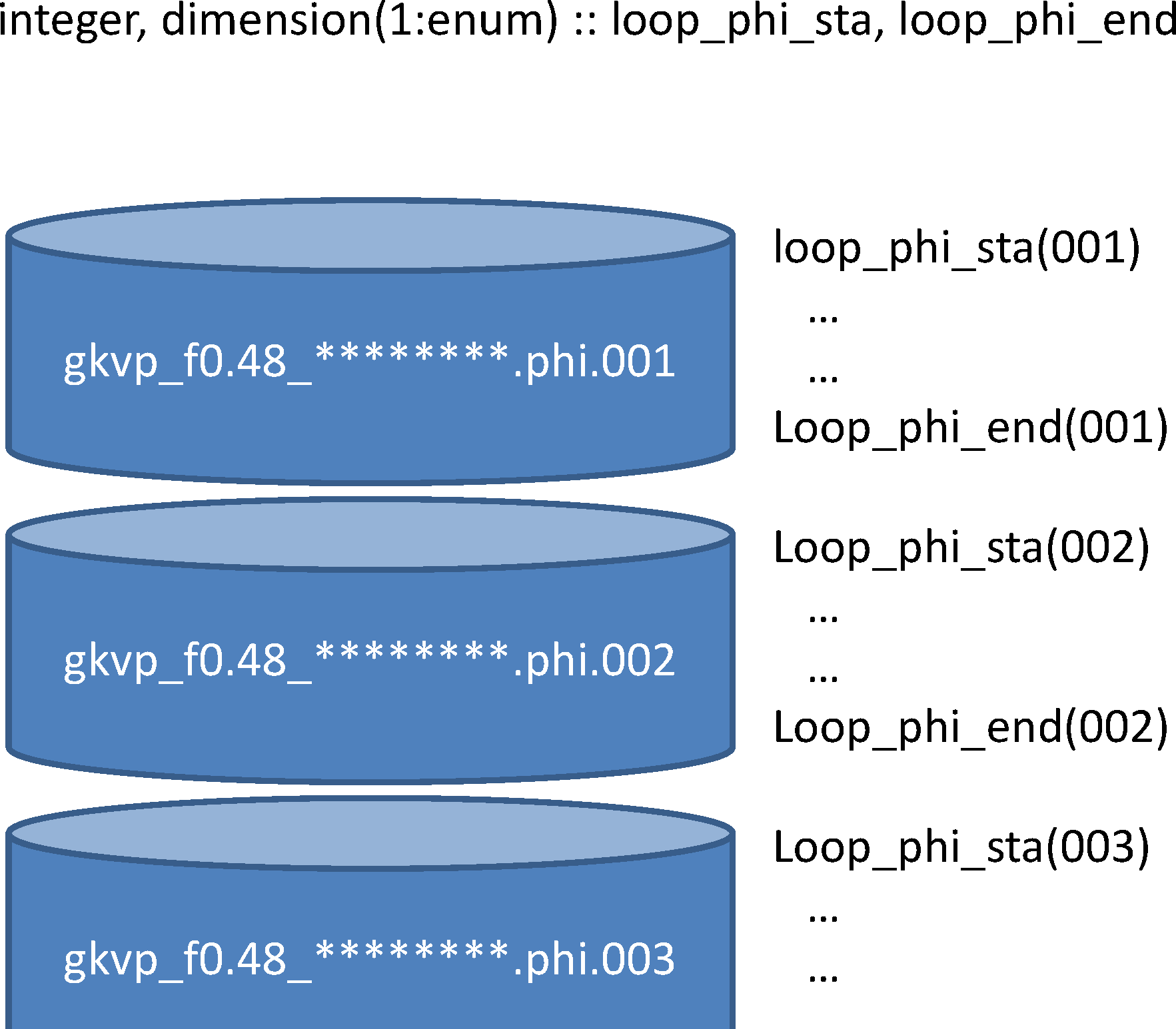
Fig. 1
Output record number in the post-processing program
diag

To read GKV binary output in the post-processing program
diag
, use the
data-reading module
diag_rb
.
use diag_rb, only : rb_phi_loop
complex(kind=DP) :: phi(-nx:nx, 0:global_ny, -global_nz:global_nz-1)
integer :: loop = 100
call rb_phi_loop(loop, phi) ! Read potential phi at output record loop=100 (time=dtout_ptn*loop)
The output record number
loop
is counted up from the first run
(
inum
=1) by evaluating file size of GKV binary output. As shown in
Fig. 1
, output record number for the
binary output
$DIR/phi/*phi*
is from
loop_phi_sta
(001) = 0 to
loop_phi_end(enum)
=
nloop_phi
. Therefore, even if you analyze only
run numbers from
snum
\(>1\)
to
enum
, all GKV binary output data from
inum
=1 should be left in the diagnosed directory.
Taking a look at the source code of
diag_rb
, one finds various types
of subroutines which read electrostatic potential
\(\tilde{\phi}_{\bm{k}}\)
in
\((k_x,k_y,z)\)
or in
\((k_x,k_y)\)
at a given
\(z\)
or in
\((z)\)
for a given mode
\(k_x, k_y\)
, etc., and similarly read
magnetic vector potential
\(\tilde{A}_{\parallel\bm{k}}\)
, fluid moments,
and so on. Some typical subroutines are listed below.
One may find more efficient subroutine in the source code of
diag_rb
.
List of subroutines in the data-reading module
diag_rb
|
Field |
Description |
|---|---|
|
Arguments |
|
|
GKV binary output |
phi/gkvp_f0.48_(rankg in 6 digits).0.phi.(inum in 3 digits) |
|
Description |
Read simulation time \(time\) corresponding to the output record \(loop\) . ( \(time \simeq dtout\_ptn \times loop\) ) |
|
Field |
Description |
|---|---|
|
Arguments |
|
|
GKV binary output |
phi/gkvp_f0.48_(rankg in 6 digits).0.Al.(inum in 3 digits) |
|
Description |
Read simulation time \(time\) corresponding to the output record \(loop\) . ( \(time \simeq dtout\_ptn \times loop\) ) |
|
Field |
Description |
|---|---|
|
Arguments |
|
|
GKV binary output |
phi/gkvp_f0.48_(rankg in 6 digits).(ranks in 1 digit).mom.(inum in 3 digits) |
|
Description |
Read simulation time \(time\) corresponding to the output record \(loop\) . ( \(time \simeq dtout\_ptn \times loop\) ) |
|
Field |
Description |
|---|---|
|
Arguments |
|
|
GKV binary output |
phi/gkvp_f0.48_(rankg in 6 digits).(ranks in 1 digit).trn.(inum in 3 digits) |
|
Description |
Read simulation time \(time\) corresponding to the output record \(loop\) . ( \(time \simeq dtout\_eng \times loop\) ) |
|
Field |
Description |
|---|---|
|
Arguments |
|
|
GKV binary output |
phi/gkvp_f0.48_(rankg in 6 digits).0.phi.(inum in 3 digits) |
|
Description |
Read electrostatic potential \(phi\) corresponding to the output record \(loop\) . ( \(time \simeq dtout\_ptn \times loop\) ) |
|
Field |
Description |
|---|---|
|
Arguments |
|
|
GKV binary output |
phi/gkvp_f0.48_(rankg in 6 digits).0.Al.(inum in 3 digits) |
|
Description |
Read vector potential \(Al\) corresponding to the output record \(loop\) . ( \(time \simeq dtout_ptn \times loop\) ) |
|
Field |
Description |
|---|---|
|
Arguments |
|
|
GKV binary output |
phi/gkvp_f0.48_(rankg in 6 digits).(ranks in 1 digit).mom.(inum in 3 digits) |
|
Description |
Read a fluid moment \(mom\) corresponding to the output record \(loop\) ( \(time \simeq dtout\_ptn * loop\) ), where \(is\) specifies the plasma species, and \(imom=0-5\) correspond to \(\tilde{n}_{\mathrm{s}\bm{k}}\) , \(\tilde{u}_{\parallel\mathrm{s}\bm{k}}\) , \(\tilde{p}_{\parallel\mathrm{s}\bm{k}}\) , \(\tilde{p}_{\perp\mathrm{s}\bm{k}}\) , \(\tilde{q}_{\parallel\parallel\mathrm{s}\bm{k}}\) , \(\tilde{q}_{\parallel\perp\mathrm{s}\bm{k}}\) . |
|
Field |
Description |
|---|---|
|
Arguments |
|
|
GKV binary output |
phi/gkvp_f0.48_(rankg in 6 digits).(ranks in 1 digit).trn.(inum in 3 digits) |
|
Description |
Read a variable corresponding to the entropy balance \(trn\) at the output record \(loop\) ( \(time \simeq dtout\_eng * loop\) ), where \(is\) specifies the plasma species, and \(itrn=0-11\) correspond to perturbed gyrocenter entropy, electrostatic field energy including polarization, magnetic field energy, wave-particle interaction via electrostatic fluctuations, wave-particle interaction via magnetic fluctuations, nonlinear entropy transfer via \(\bm{E}\times\bm{B}\) flows, nonlinear entropy transfer via magnetic flutters, collisional dissipation, particle flux by \(\bm{E}\times\bm{B}\) flows, particle flux by magnetic flutters, energy flux by \(\bm{E}\times\bm{B}\) flows, energy flux by magnetic flutters. |